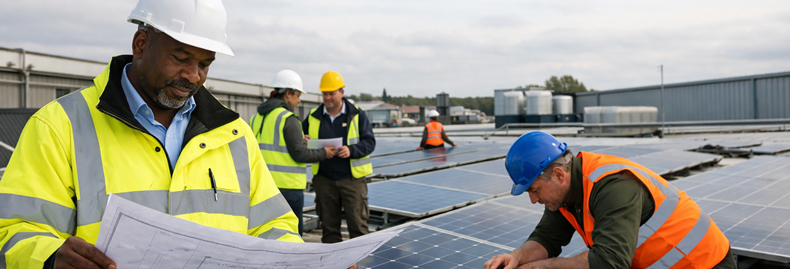
Why wind is considered carefully
Wind does more than pass over a building. As it moves across a roof, it can create uplift forces that act on both the structure and anything mounted on it. Solar panels introduce additional surfaces that interact with these forces, so attention usually turns to how the system behaves under different conditions.
Understanding uplift forces
Uplift occurs when wind pressure above a surface is lower than the pressure beneath it, effectively pulling upwards. On large flat roofs, this effect can be significant, particularly at edges and corners. Solar panels can amplify these forces if they are not positioned and fixed correctly.
Building height and exposure
The level of wind loading depends heavily on where the building sits. Open sites, coastal locations, and elevated positions tend to experience higher wind speeds. Taller buildings are also exposed to stronger forces than low-rise structures. Surrounding buildings can either shield or increase wind effects depending on layout.
Panel layout and system design
The way panels are arranged influences how wind flows across the roof. Spacing, tilt angle, and orientation all play a part. Systems designed without considering these factors may be more exposed to uplift or movement. Design is therefore tailored to the building rather than applied as a standard pattern.
Fixing methods and stability
Different systems respond to wind in different ways. Ballasted systems rely on weight to resist uplift, while mechanically fixed systems transfer forces into the roof structure. Hybrid approaches combine both methods. The appropriate choice depends on structural capacity and exposure conditions.
Edge zones and higher risk areas
Wind forces are not evenly distributed across a roof. Edges, corners, and perimeter zones typically experience higher uplift pressures. These areas often require additional attention in both design and fixing to maintain stability.
Consequences of inadequate fixing
If wind forces are not properly accounted for, there is a risk of movement, damage to panels, or in extreme cases detachment. This can lead to damage to the building itself or surrounding property. For this reason, insurers tend to focus on how systems are designed and secured rather than the panels alone.
How these risks are usually managed
Wind-related risks are normally addressed through design calculations, appropriate fixing methods, and consideration of site conditions. When these factors are taken into account, solar systems can be installed in a way that remains stable under expected wind loads. On commercial sites, this is typically reviewed alongside structural and electrical factors so that the overall design works as a whole.